 11
11
By VR Insider Staff | March 2026
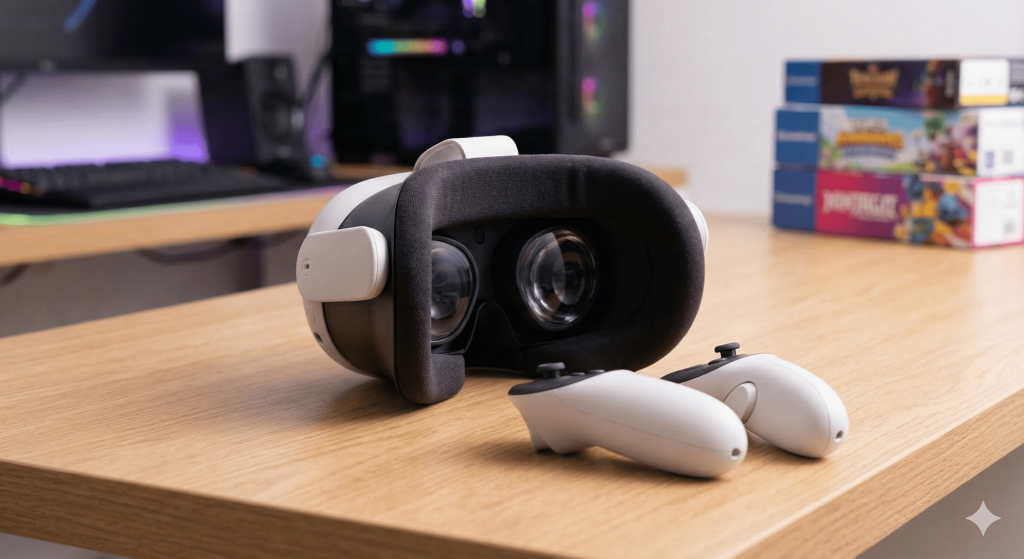
It’s 3:30 AM. The house is silent, the lights are dimmed, and for one user, the world has just shattered. This isn’t a ghost story, and it’s not a fever dream. It’s the result of putting on a Meta Quest 3 after years of using the Quest 2. But this wasn’t just a “cool upgrade”—it was a sensory event so profound that it triggered full-blown panic attacks, physical tremors, and a “bad trip” that forced the user to flee back into the physical world.
In the tech world, we often talk about “iterative updates.” We talk about 10% more pixels or 20% faster processors. But in 2026, we have reached a tipping point where the hardware is no longer just “simulating” an image; it is convincing the primitive parts of our lizard brains that we are standing somewhere we aren’t. And as it turns out, the human brain isn’t always ready for that level of deception.
To understand why someone would have a panic attack over a piece of plastic and glass, you have to understand the optics. For years, the Quest 2 (and almost every other major headset) used Fresnel lenses. These lenses were recognizable by their concentric ridges—rings that looked like a target. They were cheap to make but had a massive flaw: the “Sweet Spot.”
With Fresnel lenses, if your eye strayed even a millimeter from the center, the world became a blurry, god-awful mess of “god rays” and light smearing. Your brain always knew it was looking at a screen because the edges of your vision were constantly reminding you of the hardware. You were essentially looking through a dirty porthole.
The Pancake Lenses in the Quest 3 removed the porthole. These lenses use polarized light folding to create a crystal-clear image from edge to edge. When you put on a Quest 3, the “Screen Door Effect” is gone. The blur is gone. For a user who is perhaps a bit “elevated” (as our subject was, admitting to being quite high at the time), the lack of visual friction means the brain stops filtering the experience as “fake.”
Imagine being in a state of heightened sensitivity. You put on the Quest 3. Suddenly, the PCVR world—rendered by a high-end 2026 GPU—isn’t just a game. It is a persistent, ultra-sharp reality. Because the pancake lenses offer such a smooth, clear focal plane, the “accommodation-vergence conflict” (the thing that usually tells your brain ‘hey, this is a screen’) is significantly reduced.
The result? Total Presence. And for some, Total Presence in a digital void is terrifying. The shaky hands and panic reported by the user are classic signs of the brain’s “uncanny valley” response being pushed to the limit. The body thinks it is in one place, the eyes are 100% convinced they are in another, and the nervous system shorts out.
It’s not just the lenses; it’s what’s being fed into them. The user mentioned the jump in PCVR quality specifically. By 2026, we are seeing real-time path tracing in VR. Light bounces off surfaces exactly as it does in the real world. Shadows are soft, reflections are accurate, and textures are “Retina-grade.”
When you combine the Quest 3’s optics with the raw power of a modern gaming rig, you aren’t playing a game anymore. You are inhabiting a space. If that space is too vast, too dark, or too “smooth,” it can feel alien. The user described it as a “bad trip,” which is an apt description for a sensory experience that the mind cannot categorize or control.
There is a documented phenomenon in VR known as Dissociation. After a long session in a high-fidelity environment, users often report feeling “weird” when they take the headset off. Their real hands don’t feel like their own; the real world feels “flat” or “fake.”
What our user experienced was the reverse: Real-Time Displacement Anxiety. The transition from the Quest 2 (a toy) to the Quest 3 (a portal) was so sudden that the brain’s defense mechanism—anxiety—kicked in. The “scared and shaky” feelings are the body’s way of saying, “Something is wrong with my perception of space-time.”
As we push toward 8K per eye and 144Hz refresh rates, we have to ask: is there a limit to how much immersion a human can handle? We are moving into an era where “VR Safety” might not just mean not tripping over your cat, it might mean managing your nervous system’s response to hyper-realistic simulations.
If you find yourself in the same boat—staring at your Quest 3 box with a mix of awe and genuine fear—here is how to handle the 2026 hardware leap:
The Meta Quest 3 is a triumph of engineering, but it’s also a reminder that we are biological creatures with limits. The leap from Quest 2 to Quest 3 is, as the user put it, “beyond night and day.” It is the difference between watching a movie and living a dream.
We are glad our user is “good now,” but their story serves as a fascinating case study for the future of the medium. We wanted “Total Realism.” Now that it’s here, we might just have to learn how to live with the fear that comes with it.
***